
Last updated November 18, 2026
 Hardwood
 Engineered hardwood
 Luxury vinyl plank
 Laminate
 Porcelain tile
 Carpet
 Shaw
 Mohawk
 COREtec
 Pergo
Free in-home measure and written estimate: Shaw, Mohawk, COREtec and Pergo lines compared on your own rooms, with carpet, tile, vinyl plank, laminate and hardwood laid out side by side
Get your free estimateFlooring Installation Questions to Ask Before You Sign
The phrase “additional subfloor prep is extra” can swing a flooring contract by anywhere from a couple hundred dollars to a couple thousand, and it’s the single line homeowners skim past on the way to the total. Everyone fixates on the square-foot number. The real exposure sits in the definitions: what “demo” removes, what “level” means in writing, and who actually owns the manufacturer warranty after the installer drives away. In Summerlin homes where old vinyl or worn carpet sits over a concrete slab, that uncertainty is predictable enough to scope and cap before anyone picks up a pen. This guide gives you the exact questions, and the language, to make vague answers into contractual commitments.
Quick Answer
Before you sign a flooring contract, lock down five things in writing: the precise scope of demo and disposal, the contractor’s Nevada C-16 license number and a certificate of insurance naming your property, whether the installation crew is employed or subcontracted, who holds and registers the manufacturer installation warranty, and the written change-order process for anything discovered mid-demo. Get those five answered on paper and the rest of the contract becomes far easier to read. Price matters, but scope, warranty ownership, and change-order protocol are what protect a Summerlin project once the old floor is up.
Styles & brands we work with
- Hardwood
- Engineered hardwood
- Luxury vinyl plank
- Laminate
- Porcelain tile
- Carpet
- Shaw
- Mohawk
- COREtec
- Pergo
Table of Contents
- What’s actually included in “demo and haul-away”?
- What does “level subfloor” mean in their bid?
- How do you verify the C-16 license and insurance?
- Is the crew employed or subcontracted?
- Who owns the warranty after the job?
- What’s the change-order protocol?
- What’s the call-back and warranty-claim process?
- How do you confirm which brands and products you’re getting?
What’s actually included in “demo and haul-away”?
“Demo and haul-away” is one of the vaguest lines in any flooring bid, and it’s where scope disputes start. Ask the contractor to define, in writing, exactly what gets removed and what gets left. Does the price include pulling carpet and tack strip, scraping old adhesive off concrete, removing baseboards and reinstalling them, and disposing of everything in a dumpster they pay for? Or does “haul-away” mean the old floor gets stacked in your garage and you deal with it?
Get specific answers to these:
- Old flooring removal: Is carpet, pad, tile, vinyl, or hardwood removal included, and at what square-foot cost if the material is stubborn?
- Adhesive and thinset scraping: If the concrete in your Summerlin home carries old glue or thinset, is scraping built in or billed hourly?
- Baseboard handling: Removed and reinstalled, removed and discarded (with new baseboard billed separately), or left in place with flooring cut around it?
- Furniture moving: What does the crew move, what must you clear in advance, and what’s the charge for heavy items like a piano or a full entertainment wall?
- Disposal: Who pays for the dumpster, and does “haul-away” cover the full load or a single trip?
Ask each of these as a yes/no with a number attached. A contractor who can answer cleanly is scoping the job properly. A contractor who says “don’t worry, we handle all that” is telling you they handle it verbally, which is not the same as handling it in the contract. The written estimate is what sets the final price, so the definitions inside that estimate are what you’re really agreeing to.
What does “level subfloor” mean in their bid?
No concrete slab is perfectly flat, and no contractor should promise to hit a flatness number without measuring first. The question isn’t whether your subfloor is flat; it’s what standard the bid uses, how they measure against it, and what happens when the reading falls short. This is where the phrase “additional subfloor prep is extra” hides its real cost.
Ask these questions before the estimate gets signed:
- What flatness standard applies to this product? Different flooring requires different prep. The specific product’s installation instructions set the tolerance, not the contractor’s preference. Ask them to name the standard the manufacturer requires.
- How do you measure? A straight edge and a gauge in several spots, or a laser? Ask to see the readings on the estimate.
- What triggers an extra charge, and what’s the cap? If prep is over the standard, is there a flat allowance, an hourly rate, or is it open-ended? Get a number or a range in writing.
- What prep methods do you use? Self-leveling compound, grinding high spots, patching, a moisture barrier. Ask which one applies to your slab and why.
- Does the slab read dry enough? Concrete emits moisture, and some flooring needs a tested moisture reading before it goes down. Ask whether testing is included and what reading is required for the product.
Summerlin sits in a dry desert climate, but that does not make concrete slabs immune to trapped moisture or uneven cure. A contractor who measures at the estimate visit and puts the reading on paper is doing you a favor. A contractor who eyeballs the floor and says “it looks level” is handing you the same uncertainty you started with. If prep is needed, it should be identified before demo, not after, when the old floor is already gone and you have no leverage.
How do you verify the C-16 license and insurance?
In Nevada, flooring contractors should carry a state contractor’s license, and the relevant classification for floor covering work is C-16. Ask for the number, then verify it yourself with the Nevada State Contractors Board before signing anything. A legitimate contractor will give you the number without hesitation, and it will check out. A contractor who dodges the question has given you your answer.
Beyond the license, ask for a certificate of liability insurance that names your property, your address, and your coverage dates. Look for general liability coverage and workers’ compensation. If the crew is injured on your property and the contractor carries no workers’ comp, you’re the one exposed. The certificate should be current and issued by the contractor’s insurer, not a photocopy from years ago.
Here’s the checklist for the verification call:
- License number: Get the C-16 number in writing and check it against the state board’s database.
- License status: Active and in good standing, with no disciplinary actions you can find.
- Liability insurance: Certificate naming your address, with current dates.
- Workers’ compensation: Active policy or a valid exemption.
- Business entity: Does the name on the license match the name on the contract? A mismatch is a red flag.
This step takes ten minutes and protects thousands of dollars. Skip it and you’re trusting a handshake. Ask for the documents before the estimate is finalized so any issue surfaces while you can still walk away.
Is the crew employed or subcontracted?
Ask who will actually install the floor. Some contractors use their own employees; some sub the labor to independent installers. Neither arrangement is automatically wrong, but you deserve to know which one you’re getting, and how it affects the warranty if something fails. An installer who subcontracts may do fine work; the risk is that when a recall or claim comes up, the chain of responsibility gets fuzzy.
Ask these questions:
- Who is on the crew by name of company? If you’re hiring a licensed contractor, the install should be their responsibility, not a third party they don’t stand behind.
- Are the installers insured under the contractor’s policy? If they’re subcontracted, the contractor should still carry them for the job.
- If the crew is subcontracted, who handles a warranty call? Get the answer in writing.
- Who supervises the crew on installation day? Someone your contractor stands behind, not a name you’ll never meet again.
- How are damaged materials handled? If a board is cut wrong or a tile cracks, whose material and whose labor pays?
Subcontracted labor is common in the trade, and it can work well. The question is whether the contractor has a real relationship with the installers and a system for handling failures. If the answer is “we use whoever’s available,” the warranty is only as strong as a stranger’s memory. The whole point of hiring a specialty contractor rather than a generalist is that the craft is on their books, not someone else’s.
Who owns the warranty after the job?
Manufacturer warranties for flooring usually have two parts: the material warranty and the installation warranty. The material warranty covers the product itself. The installation warranty covers how it was put down. If something fails and the cause turns out to be installation, your first call is to the installer, and you need to know whether the contractor handles that claim or whether you deal directly with the manufacturer.
Questions to get answered on paper:
- Who registers the warranty? Is registration done by the contractor at completion, or does it fall to you? If the contractor does it, ask for proof of registration.
- What documentation do you hand me at completion? A signed completion sheet, the product invoice, the manufacturer warranty registration, and the installer’s own warranty statement.
- Who’s the first point of contact on a claim? The manufacturer, the contractor, or the installer? Get the sequence in writing.
- What’s the contractor’s own installation warranty term? Ask for the length and the exclusions.
- What’s excluded? Movement from settling foundations, water damage, improper cleaning, furniture damage, and normal wear are typically excluded. Confirm which exclusions apply to your job.
Read the manufacturer warranty document yourself, not just the summary the contractor provides. Brands like Pergo and Mannington publish their own warranty terms for the products they sell, and you should know what those terms actually say. The best installation warranty in the world doesn’t help if you never receive the paperwork that proves you’re covered.
What’s the change-order protocol?
Demo always finds something. A soft spot in the subfloor, an unexpected layer of old adhesive, a section of rotted framing under a bathroom tile. The question isn’t whether the project will need a change; it’s how that change gets priced and approved before more work proceeds. The wrong protocol leaves you with a torn-up floor and an inflated invoice you had no chance to refuse.
Here’s the protocol every contract should specify:
- Stop work: The crew stops and documents the discovery with photos and a written description before proceeding.
- Written change order: The contractor provides a separate written change order with the specific scope and price, not a verbal estimate.
- Your written approval: You approve or reject in writing, and no work resumes until you do.
- Price cap: The change order includes the maximum additional cost for that specific issue.
- Signed record: Both parties sign, and the change order becomes part of the original contract.
Ask the contractor to show you their change-order template before you sign the main contract. A contractor who can produce one has done this before and knows the process. A contractor who says “we’ll figure it out when we get there” is telling you what the pricing environment will look like once your floor is up and the job is half done. In Summerlin homes with old vinyl or carpet over concrete, the demo surprises are predictable enough that the protocol should be defined before anyone signs anything, not discovered mid-job.
What’s the call-back and warranty-claim process?
Even good installations sometimes need a small adjustment after the crew leaves. A transition strip that pops, a grout line that cracks, a carpet seam that lifts. Ask the contractor what their call-back policy actually is, in points of time and in points of coverage. “We’ll come back if there’s a problem” is not a policy; it’s a hope.
Get answers to these:
- Call-back timeframe: How long after installation will they respond to a complaint, and what’s the process for scheduling a visit?
- What’s covered under call-back? Installation defects, product failures, or both?
- What’s excluded? Damage from furniture, water, pets, improper cleaning, and normal wear.
- Who handles a product failure versus an installation failure? Different paths; both should be defined.
- How does a manufacturer claim get initiated? Paperwork, photos, inspection, the whole sequence.
- Is there a written record of the call-back policy? If not, ask for one before signing.
The call-back question is where you find out whether you hired a contractor who intends to be around, or one who’s gone once the invoice clears. A written policy with a timeframe is the difference between a company that stands behind the install and a company that treats call-backs as a negotiation. When a floor fails, you want a defined process, not a voicemail loop.
How do you confirm which brands and products you’re getting?
The installed product should be named specifically in the contract: brand, product line, color, and the square footage. “We’ll use a premium LVP” is not a product specification. It’s a placeholder. When you’re comparing resilient options, brands like Pergo and LifeProof make distinct lines with different performance characteristics, and the choice should be explicit and not left to whatever’s in the warehouse that week.
Ask these to close the loop:
- Exact product name and line: Manufacturer, product line, color name, and SKU or item number.
- Where the material is sourced: Not “we’ll pick it up,” but the specific source, so you can verify the product is what was specified.
- Square footage and waste allowance: How much material is ordered, and how much is included for cuts and waste.
- Product availability: What happens if the specified product is back-ordered or discontinued between signing and install?
- Comparison conversation: If you’re weighing Mannington against Armstrong against Pergo, can the contractor explain the differences in one conversation, or do they push whatever they stock?
The last point matters more than it sounds. A contractor who works across multiple brands has no reason to push one manufacturer’s line, and can help you compare alternatives honestly. When someone can walk you through carpet installation and tile flooring installation and hardwood refinishing in the same project conversation, they usually understand how each material behaves in a specific room, not just in a catalog.
Common Mistakes to Avoid
- Signing before the subfloor allowance is defined. “Additional prep is extra” without a cap is an open check. Ask for a written number before demo starts, not after.
- Accepting a certificate of insurance photo instead of a certificate naming your property. Coverage that doesn’t name your address may not protect you if something goes wrong on your job.
- Assuming the contractor handles warranty registration. Some do, some don’t. Confirm in writing who registers and get proof at completion.
- Letting the crew proceed after discovering a subfloor issue without a written change order. Verbal approval is not approval once the invoice arrives. Get it signed before work resumes.
- Not knowing whether installers are employed or subcontracted. The answer shapes who you call when something fails.
- Trusting verbal product specifications. “A premium LVP” is not a product line. Get brand, line, color, and SKU on the contract.
- Skipping the license check. In Nevada, a C-16 license number is verifiable in minutes. Not verifying it is a self-inflicted risk.
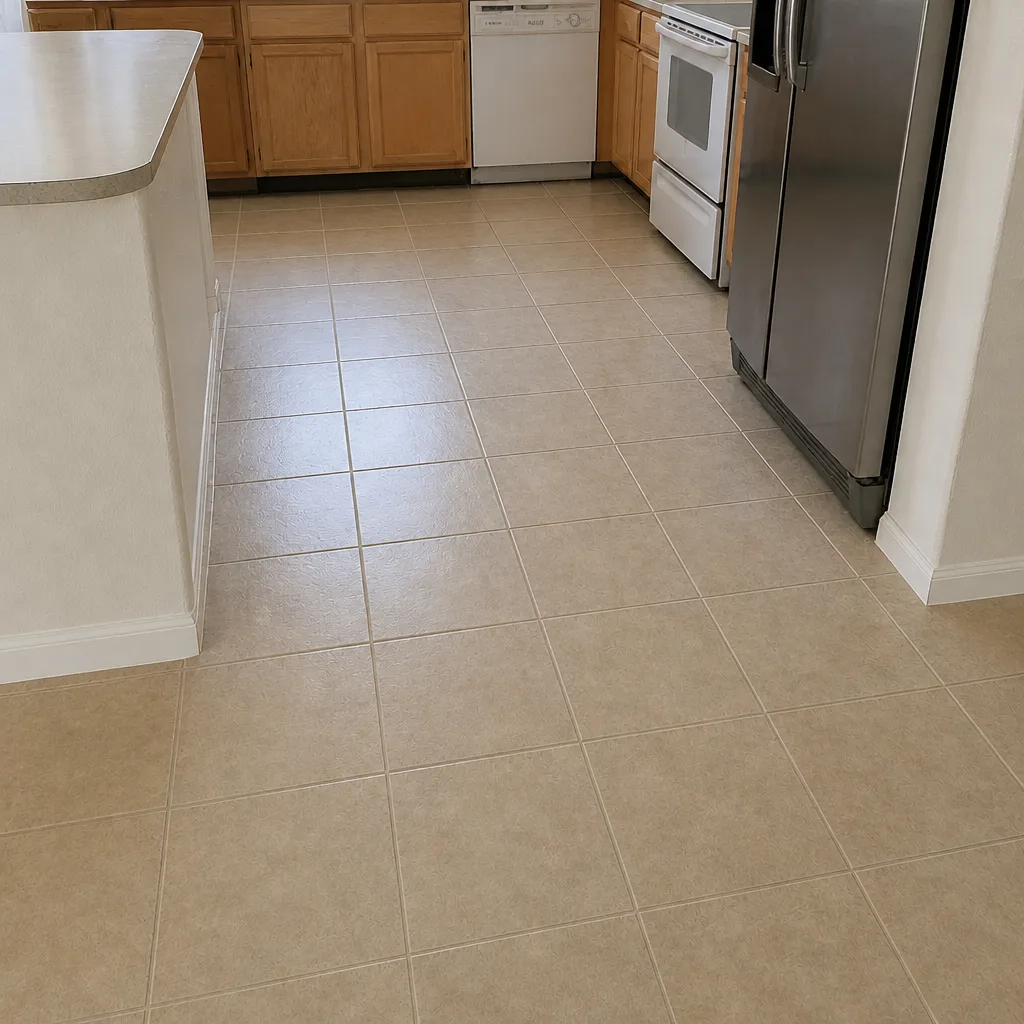
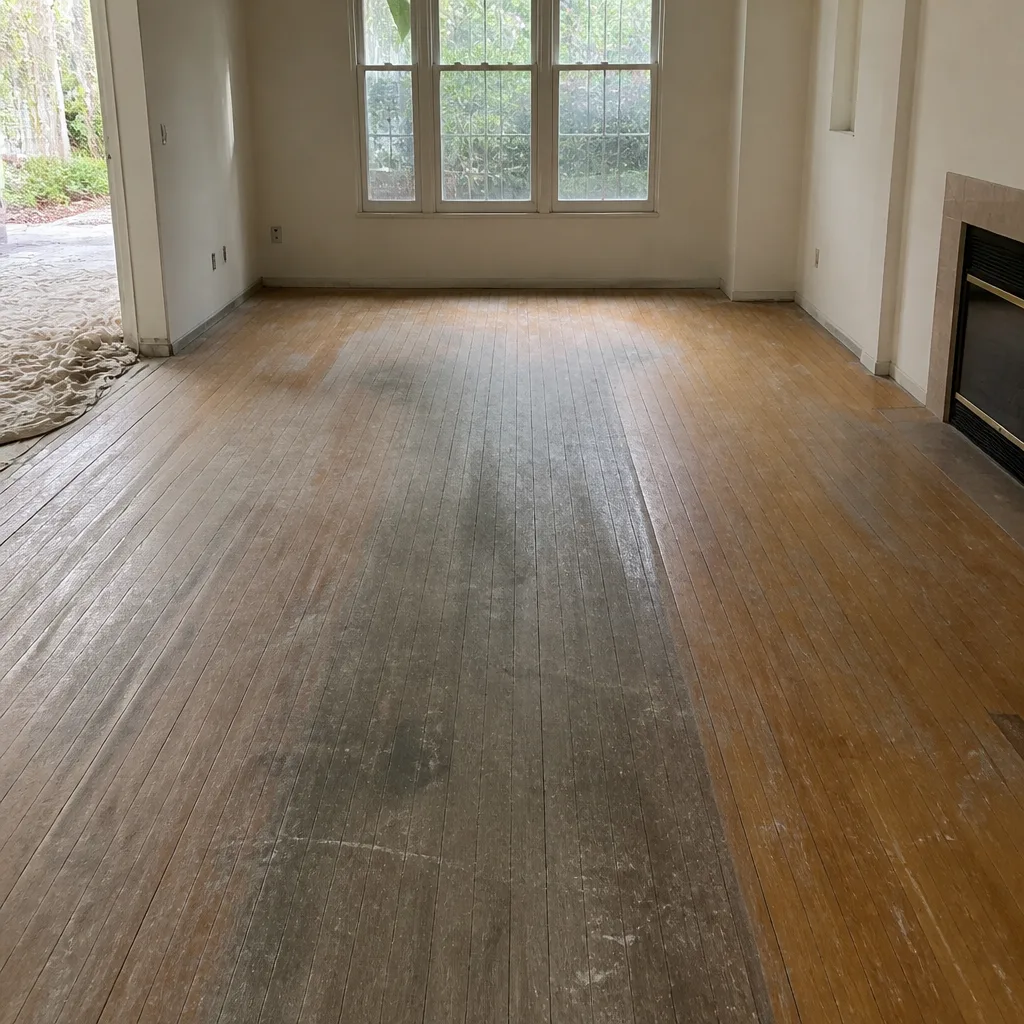
See the difference
 Before
 After
 Before
 After
 Before
 After
When to Call a Professional
Call a professional installer before you sign, not after the demo starts. The right moment to get scope, warranty, and change-order questions answered is during the estimate, when you still have leverage and the floor is intact. If any contract you’ve been handed uses the phrase “additional subfloor prep is extra” without a cap, or names a warranty the contractor doesn’t actually register, or won’t specify the installation crew, those are signs to get a second estimate before you commit. The same is true if you’re refinishing hardwood in an older home, or comparing resilient options across brands like Mannington and Armstrong and getting a single-manufacturer sales pitch. A specialty contractor should be able to walk through the trade-offs without steering you. Covering a whole-home project and want a single conversation across carpet installation and hard surface work? That is the conversation to have at the estimate. Flooring Installation Summerlin offers free estimates – call (844) 320-7082. We answer 24/7. Fast dispatch from 7am to 7pm, Sunday through Friday.
Frequently Asked Questions
A C-16 is Nevada’s contractor license classification for floor covering work. Ask for the number and verify it with the Nevada State Contractors Board before you sign. A licensed contractor is accountable to the state board; an unlicensed one is accountable to no one, and you have no recourse if the job goes wrong. Call (844) 320-7082 for an exact breakdown of what a licensed estimate looks like.
Subfloor prep should be identified and priced at the estimate, and the additional cost should be capped in the contract before demo starts. Exact cost depends on the slab and the product, so ask for the standard the bid uses and a written figure or range for any prep beyond that standard. Without a cap, “additional prep is extra” is an open-ended charge. Call (844) 320-7082 to schedule a free estimate and get the prep scoped on paper.
Manufacturer warranties typically sit with the homeowner, but the installation warranty is the contractor’s own obligation. Ask who registers the material warranty, who you call first if the product fails, and what written documentation you receive at job completion. Get both warranty terms in writing before signing. Call (844) 320-7082 for a free estimate that comes with a written warranty summary.
Yes, some. Concrete slabs in Summerlin homes with older vinyl or carpet installed over them often hide adhesive residue, minor cracks, or uneven patches that were never prepped properly. Your best protection is a contractor who measures the subfloor at the estimate and specifies in writing what triggers an additional charge. Call (844) 320-7082 to schedule your free estimate before demo starts.
Yes, and you should. A contractor who carries multiple manufacturers can match product to room and budget without steering you toward one line. If you’re only shown one brand, ask why. A true comparison should include carpet, tile, resilient, and hardwood options, not just the stock in one warehouse. Call (844) 320-7082 for a free estimate across nine recognized flooring brands.
The contractor’s liability insurance should cover accidental damage to your property during the job. Ask in advance what the process is for documenting and repairing damage, and confirm the certificate of insurance names your property address. If the answer is vague, that’s a gap. Call (844) 320-7082 for a free estimate and a written explanation of coverage.
The Bottom Line
The flooring contract is where a Summerlin project either gets protected or exposed, and the questions in this guide are the ones that shift a vague promise into a written commitment. Get the demo scope defined line by line. Confirm the C-16 license and insurance certificate before anything is scheduled. Know who’s on the crew, who owns the warranty, and who registers it. Require a written change-order protocol with a price cap before demo begins. And make sure the exact product is named in the contract, with brand and line, not a placeholder. Price is the last thing you should be negotiating. Scope is the first. When you’re ready to compare real options across carpet, tile, and hardwood, get a free estimate in writing, with the warranty terms attached. We install across Summerlin, and we can also walk you through Flooring Installation Summerlin options alongside the wider service area, including Sandy Valley, and pair the right product with the right room.
Our technicians have up to 9 years of experience installing and finishing floors across the valley. Call (844) 320-7082 for a free estimate. We answer 24/7. Fast dispatch from 7am to 7pm, Sunday through Friday.
Written by the team at Flooring Installation Summerlin.