
Carpet or Hard Flooring for a Bedroom: How to Decide
Here’s the most common mistake we see with bedroom flooring: choosing it like you’re choosing wallpaper. A bedroom isn’t a showroom. It’s the room where you walk barefoot at 6am in January, where you drop a glass at midnight, and where noise carries to the room below. Carpet wins on warmth, acoustics, and cushion underfoot. Hard flooring wins on cleanup, dust control, and design flow with the rest of the house. The right answer depends on who sleeps there, how the room actually lives, and what the subfloor can support. If you’d rather not sort it out on your own, call (844) 320-7082 and we’ll walk through it with you.
Start With Comfort: Why a Cold Bedroom Floor Isn’t Just a Feeling
Step barefoot onto tile at dawn in a Summerlin house with a slab foundation and you’ll understand immediately. The tile isn’t actually colder than the air. It conducts heat away from your foot much faster than carpet does, so it feels colder. Slab foundations make this worse because there’s no wood or joist cavity between your floor and the ground to break the transfer.
This matters more in Summerlin than most people expect. Summerlin homes are built on slab, and many have large windows that gain solar heat through the day, then cool down fast at night. That swing makes a hard bedroom floor feel even chillier in the early morning hours, especially through the winter months.
Where each floor type lands on the comfort question:
- Carpet: The warmest surface underfoot. Insulates against a cold slab and softens sound.
- Luxury vinyl plank (LVP): Warmer than tile because it’s a thinner material with a slightly softer feel, but still a hard surface. Karndean and COREtec planks are what most Summerlin homeowners look at when they want a hard floor but not tile.
- Engineered or solid hardwood: Warmer than tile for the same reason wood has always been warmer than stone. Armstrong and Shaw both have bedroom-ready options.
- Tile: The coldest underfoot. Great in a bathroom, tougher in a bedroom without radiant heat.
If radiant heat is in the picture, the comfort gap narrows significantly. If it isn’t, carpet or a wood-look plank is usually the more forgiving choice for a bedroom in Summerlin.
Who Sleeps There? The Occupant Profile Test
The bedroom isn’t one room type. A primary bedroom, a kids’ room, a guest room, and an aging-in-place bedroom each have different priorities. Here’s how we usually think through each one.
Primary bedroom
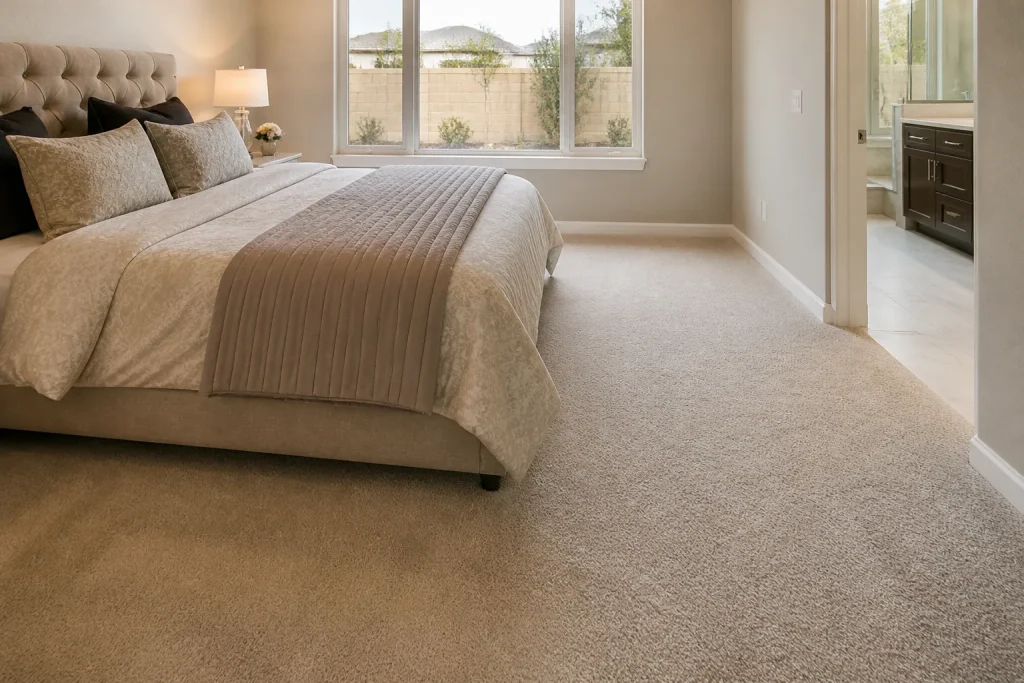
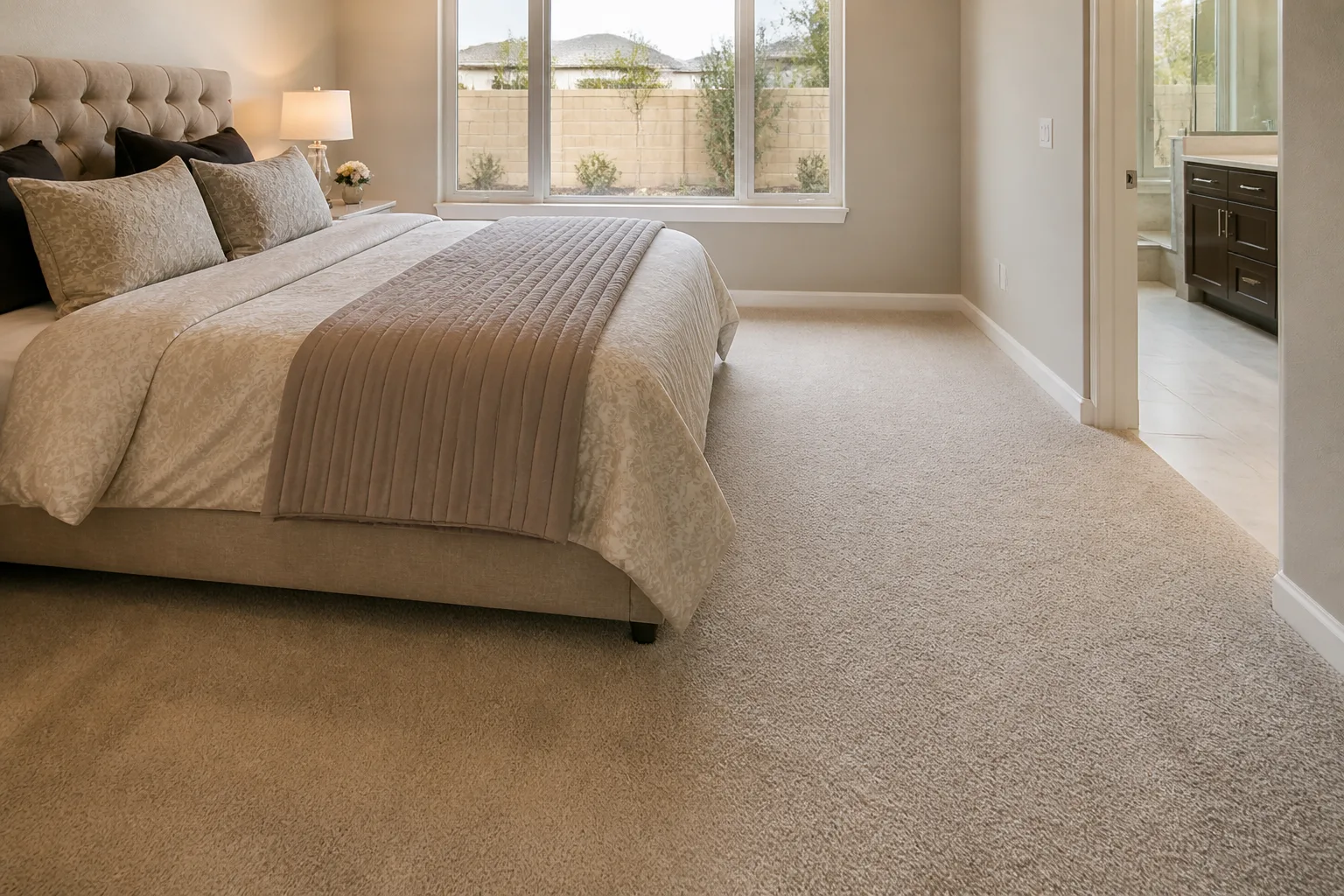
Comfort and quiet carry the most weight. If the room sits above a living area or next to a bathroom, carpet absorbs sound in a way hard flooring can’t. Carpet installation is often the right call here, though many Summerlin homeowners choose a wood-look plank if they prefer a hard surface and don’t mind a rug under the bed.
Kids’ room
Durability and cleanup matter more than warmth. Kids spill juice, drag toys, and occasionally test gravity off the top bunk. A water-resistant LVP or a Shaw or Mohawk carpet with a low pile are both reasonable. Carpet softens falls; hard flooring is easier to wipe down after a stomach bug. Pick based on which of those two realities you’d rather handle.
Guest room
Low traffic, occasional use. This is where carpet makes the most financial sense. A mid-grade carpet at a reasonable price gives the room a warm, finished feel without a big spend. Hard flooring here rarely earns its cost because the room simply isn’t used enough to justify the durability premium.
Aging-in-place bedroom
Safety beats comfort. A firm, low-pile carpet or a smooth hard floor with a properly installed transition strip reduces trip risk. Loose rugs and deep-pile carpet are the wrong choices. If mobility is a real concern, a hard surface with a low transition is usually the safer layout.
What the Research Actually Says About Carpet and Allergens
The claim that hard floors are always better for allergy sufferers is more nuanced than most articles make it sound. Here’s the honest version.
Hard surfaces are easier to wipe clean, so pollen, dust, and pet dander that settle on them can be removed with a damp mop. Carpet traps particles in its pile. That sounds like a disadvantage, and for some people it is.
But “traps” cuts both ways. Carpet also holds those particles down rather than letting foot traffic kick them back into the air. Some research suggests that, when carpet is well maintained, it can actually reduce airborne particulate in a room compared to a hard surface that’s been stirred up. The key phrase is well maintained. A carpet that gets vacuumed regularly and cleaned periodically behaves differently from one that doesn’t.
What we tell Summerlin homeowners who ask:
- If someone in the home has a diagnosed respiratory condition, talk with their doctor before deciding. We’re not medical professionals, and this isn’t a health recommendation.
- If the concern is general dust and pet hair, a hard floor is easier to keep visibly clean.
- If you choose carpet, plan on regular vacuuming and periodic deep cleaning.
- Dust and allergens can also come from old carpet padding, so replacing worn carpet is often more important than the carpet-vs-hard-floor debate itself.
We won’t make allergy promises about any product. What we can do is help you pick a floor that fits how you actually clean and live.
The Acoustic Angle: Why Carpet Still Wins in Two-Story Homes
Impact noise is the bedroom flooring issue nobody mentions until they’ve lived with it. Walking on a hard floor upstairs sends thuds straight down through the joists. Carpet and its padding absorb much of that impact before it ever reaches the ceiling below, which is why carpet remains the standard choice for upper-floor bedrooms in Summerlin’s two-story homes.
The gap is real. A hard surface like LVP or laminate transmits more impact sound down through the structure than carpet does, because there’s almost nothing between the plank and the subfloor to dampen the vibration. Hard-floor advocates often point to acoustic underlayments, and those do help, but the difference between carpet and a hard floor is still noticeable from the room below.
Two scenarios where this matters most:
- Bedroom above a living room or nursery. Carpet in the bedroom, hard floor in the living room, and the sound issue mostly disappears.
- Bedroom above another bedroom. If both rooms have hard floors, you’ll hear every midnight bathroom trip. Carpet in at least the upper room fixes it.
If you’re set on hard flooring in an upstairs bedroom, ask about an acoustic underlayment at the estimate. It won’t match carpet for quiet, but it’s a real improvement over bare plank on joists.
Thermal Performance on Slab Foundations in Summerlin
Most Summerlin homes sit on slab. That single fact changes the bedroom floor conversation more than any brand comparison. With no crawlspace or joist cavity, the slab acts as a thermal mass, and whatever sits on top of it takes on its temperature.
Tile on a slab is the coldest combination. It’s dense, it conducts heat quickly, and it has no give. In a bedroom, that means a hard, cold surface that some homeowners find they don’t want to walk on barefoot at all.
LVP and engineered wood do better. They’re less dense and sit on a thin underlayment in most installations, so they feel noticeably warmer than tile even without radiant heat. If the slab has radiant heat pipes or mats, the gap narrows further, and either tile or plank becomes comfortable. If it doesn’t, plank or carpet is usually the more forgiving choice.
We also check the slab itself during a free estimate. Moisture in a slab can affect the flooring that goes over it, and the right product depends on what we find. That’s part of why we recommend a written estimate before any bedroom floor is chosen.
Resale Value Reality: When Carpet Is the Smarter Financial Choice
Plenty of advice says any buyer will discount a home with carpet. In Summerlin, that’s only partly true. It depends on the room, the carpet condition, and the buyer pool.
Where new carpet wins:
- Clean, mid-grade carpet in a bedroom is standard, and most buyers expect it. A well-installed, neutral carpet doesn’t cost you money on resale.
- Fresh carpet in a guest or secondary bedroom is often cheaper than hard flooring for the same room and looks finished on a listing.
- If a buyer plans to replace the floor to their own taste anyway, the current flooring barely affects the price.
Where carpet loses ground:
- Worn, stained, or dated carpet in a primary suite can read as a fix-it item, and buyers in Summerlin do price that in.
- If every other room in the home is a hard surface, a carpet-only bedroom can feel inconsistent. That’s a design issue more than a value issue, but it affects first impressions.
- If the home has original hardwood underneath the carpet, removing the carpet and refinishing is often the smarter move financially. We do this work, and we frequently recommend it.
Our honest recommendation: don’t buy bedroom flooring as a resale bet unless you’re selling soon. Choose for how the room lives now. Buyers usually follow good function.
When to Call a Pro
Some bedroom floor decisions are genuinely simple: pick a color, buy a roll, lay it out. Others aren’t. Call a professional when:
- You’re not sure whether the slab is dry enough for the product you want.
- You’re removing carpet and don’t know what’s underneath it. That’s how a lot of great original hardwood gets found.
- You need a seamless transition between a bedroom floor and the hallway or stair.
- The room has radiant heat, and you want to be sure the product works with it.
- There’s a slope, a squeak, or an old repair in the subfloor.
When you’re ready, our flooring installation Summerlin service starts with a free in-home measure and a written estimate. Our technicians have up to 9 years of experience, and we handle carpet installation, tile flooring installation, and hardwood refinishing under one contractor.
Related services in Summerlin: carpet installation for bedrooms, bedrooms that sit above a living area, and homeowners who want a hard surface that still feels warm underfoot.
The Bottom Line
There’s no universal right answer to carpet versus hard flooring in a bedroom, and anyone who tells you otherwise is selling something specific. Carpet wins on warmth, acoustics, and cushion, especially on a slab foundation and especially in an upstairs room. Hard flooring wins on cleanup, allergen control, and design consistency with the rest of the house. The deciding factors are who sleeps there, how the room is used, what the slab supports, and whether radiant heat is in the picture.
If you’re in Summerlin and want a second set of eyes on the choice, we can help. Flooring Installation Summerlin carries carpet, tile, LVP, and other options from nine brands, including Shaw, Armstrong, Daltile, and Karndean, so you can compare real alternatives in one conversation instead of driving between five stores. Free estimates, written quotes, upfront pricing. Call (844) 320-7082. We answer 24/7. Fast dispatch from 7am to 7pm, Sunday through Friday. Our service area includes Sandy Valley and the surrounding communities.
Frequently Asked Questions
Carpet is generally better for warmth, quiet, and comfort underfoot in a bedroom, especially on a slab foundation or an upper floor. Hardwood or a wood-look plank is better if you want easier cleanup and design flow with the rest of the home. The right choice depends on who sleeps in the room and how the subfloor is built. Call (844) 320-7082 and we’ll help you compare both options in one visit.
Carpet is usually the most budget-friendly way to finish a bedroom floor, since the material and installation cost less per square foot than hardwood or tile. LVP is the next tier up and costs more than carpet but less than hardwood in most cases. The written estimate sets the final price for your room. Call (844) 320-7082 to schedule a free in-home estimate.
No. We don’t recommend covering hardwood with carpet. If original hardwood is under the old carpet, refinishing it usually makes more sense than covering it up. We offer hardwood refinishing as a separate service, and we’ll check what’s under the carpet during the estimate. Call (844) 320-7082 to get a professional assessment.
Tile on a slab foundation is the coldest option and can feel uncomfortable underfoot in winter. LVP and engineered wood feel noticeably warmer because they conduct heat less aggressively than tile. Carpet is the warmest surface overall. If radiant heat is installed, any hard floor becomes comfortable. Call (844) 320-7082 for a free estimate that takes your subfloor into account.
Written by the team at Flooring Installation Summerlin.
Need Flooring Help?
Call Flooring Installation Summerlin - licensed & insured, here with fast help in Summerlin.
(844) 320-7082